Table of Contents
ToggleA backyard without overhead protection is like a workshop without a roof, it does the job on clear days but leaves you scrambling when conditions turn. Whether it’s midday sun that turns patio furniture into branding irons or sudden rain that sends guests inside mid-meal, uncovered outdoor space limits how and when homeowners can actually use it. The right backyard cover extends living space, protects furniture from UV damage and moisture, and can increase property value. From traditional pergolas to modern shade sails, each option balances coverage, ventilation, aesthetics, and budget differently.
Key Takeaways
- Backyard cover ideas protect furniture from UV damage, prevent wood rot and rust, and can return 50-80% of installation costs at resale, making them a worthwhile home investment.
- Pergolas offer 50-70% sun blocking with open-lattice design and natural airflow, while gazebos provide full rain and sun protection with solid roofing and cost $1,500-20,000+ depending on materials and customization.
- Retractable awnings and shade sails deliver flexible coverage solutions: awnings preserve aesthetics when retracted, while shade sails offer modern styling and budget-friendly pricing at $200-800 per sail with 85-95% UV blocking.
- Proper foundation work below the frost line is critical for all permanent backyard cover structures, with digging depth ranging from 12-48 inches depending on regional climate zones.
- DIY installation works well for shade sails, prefab pergolas, and freestanding canopies, but hire professionals for custom structures, roof attachments, electrical work, or projects requiring building permits.
- Combining materials—such as pergolas with climbing plants or retractable fabric canopies—creates adaptable coverage for varying weather conditions while maintaining long-term usability.
Why Every Backyard Needs a Cover
Uncovered outdoor spaces sit unused for significant portions of the year. Direct sun exposure causes composite decking to reach surface temperatures above 150°F, making bare feet a painful proposition. UV radiation also degrades outdoor fabrics, fades cushions, and warps plastic furniture within a single season.
Beyond comfort, a backyard cover provides functional weather protection. Rain doesn’t just ruin dinner parties, it accelerates mold growth on wood surfaces and causes metal hardware to rust prematurely. Covers reduce maintenance cycles and extend the lifespan of grills, fire pits, and seating.
There’s also the usability factor. Outdoor entertaining becomes practical year-round with adequate overhead protection. A covered area maintains comfortable temperatures during peak sun hours and provides refuge during light rain, effectively adding square footage to a home’s functional living space.
Property value is another consideration. Outdoor structures typically return 50-80% of their installation cost at resale, depending on quality and regional climate. Buyers in sun-heavy markets particularly value shade structures, while those in temperate zones appreciate rain protection that enables outdoor use through shoulder seasons.
Pergolas: The Perfect Blend of Style and Shade
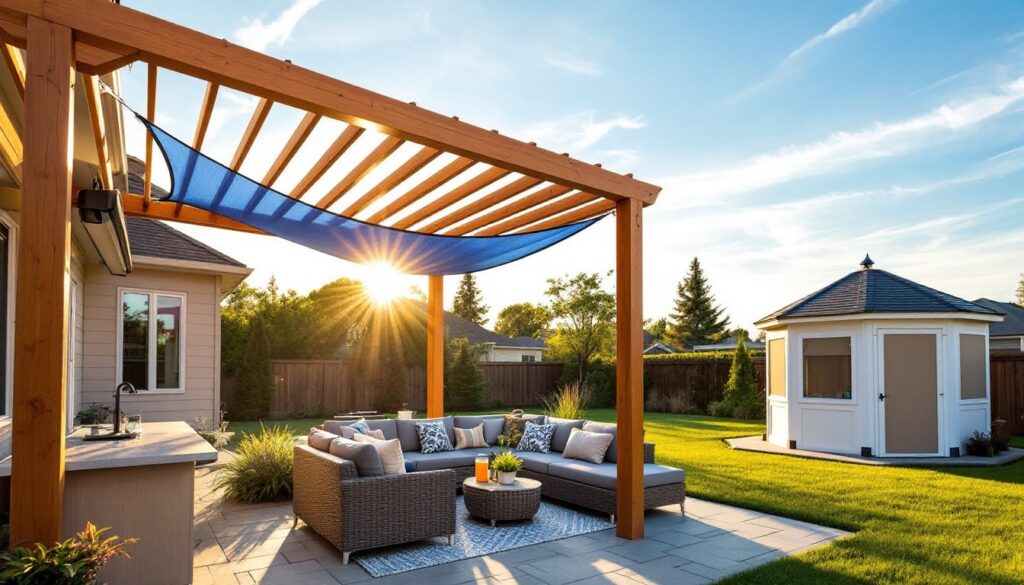
Pergolas offer partial shade through open-lattice roofing supported by posts and crossbeams. They don’t provide full rain protection, but the slatted roof (typically spaced 12-16 inches apart) blocks 50-70% of direct sunlight while maintaining airflow, crucial in humid climates where solid roofs trap heat.
Standard materials include pressure-treated pine (most budget-friendly at $10-15 per linear foot), cedar ($18-25 per linear foot, naturally rot-resistant), and vinyl or aluminum ($25-40 per linear foot, virtually maintenance-free). Wood pergolas require annual sealing or staining to prevent weathering and insect damage. Aluminum options eliminate that upkeep but lack the warmth of natural wood grain.
Most pergolas use 4×4 or 6×6 posts set in concrete footings below the frost line (check local frost depth, it ranges from 12 inches in southern zones to 48+ inches in northern climates). Crossbeams are typically 2×6 or 2×8 lumber, and the rafters (the slats creating shade) run perpendicular at 2×4 or 2×6 dimensions.
Many homeowners add climbing plants like wisteria or grapevines for additional shade, though this increases the structural load and requires sturdier framing. Retractable fabric canopies are another popular upgrade, converting partial shade to near-full coverage when needed. This approach keeps a covered outdoor entertainment area adaptable for varying weather conditions.
Permitting note: Pergolas under 200 square feet often don’t require permits, but attached structures or those over a certain height trigger code reviews in many jurisdictions. Always check local building department requirements before purchasing materials.
Gazebos for a Classic Covered Retreat
Unlike pergolas, gazebos feature a solid or near-solid roof (asphalt shingles, metal panels, or polycarbonate), providing full rain and sun protection. The traditional octagonal or hexagonal design with open sides creates a standalone structure rather than an attached extension of the home.
Gazebos range from prefab kits ($1,500-5,000 for an 8×10-foot model) to custom-built structures ($8,000-20,000+ depending on size, materials, and finishes). Prefab kits typically use cedar or pressure-treated framing with a steel or asphalt shingle roof, arriving in pre-cut sections for assembly over a weekend.
Foundation is critical. Small gazebos (under 100 square feet) can sit on a compacted gravel base with concrete deck blocks at each post, but larger or permanently attached structures need concrete footings extending below frost line to prevent heaving. Posts are usually 4×4 or 6×6, and roof rafters follow standard residential framing with a central hub distributing load across the perimeter.
Ventilation is often overlooked in solid-roof designs. Without proper airflow, gazebos trap heat and moisture, creating uncomfortable microclimates. Cupolas (the decorative caps on top) aren’t just ornamental, they provide passive ventilation that exhausts hot air. Some designs also incorporate screened walls to block insects while maintaining cross-breeze.
Electrical and permits: Adding lighting or ceiling fans requires running electrical service, which typically means hiring a licensed electrician and pulling permits per NEC (National Electrical Code) Article 225 for outdoor branch circuits. GFCI protection is mandatory for all outdoor receptacles.
Retractable Awnings and Canopies for Flexible Coverage
Retractable awnings mount to exterior walls and extend outward on demand, providing shade without the permanent footprint of a pergola or gazebo. When retracted, they disappear against the house, preserving sightlines and architectural aesthetics.
Most residential awnings use acrylic or polyester fabric treated for UV resistance and water repellency (Sunbrella is a common brand name, known for 5-10 year fade warranties). Fabric is stretched over articulated aluminum arms that extend 8-14 feet from the mounting point. Motorized models add convenience but require electrical service at the mounting location.
Key measurements: Projection (how far the awning extends) and width. Standard projections are 8, 10, or 12 feet. Width typically ranges from 8-20 feet for residential applications. For backyard event spaces, wider models provide better coverage but require stronger mounting surfaces due to increased wind load.
Installation demands solid attachment points, ledger boards or directly into wall studs through exterior cladding. Vinyl siding alone won’t support the load: backing must reach framing or masonry. Wind sensors are a smart addition: they automatically retract the awning when gusts exceed safe thresholds (typically 20-25 mph), preventing damage.
Freestanding canopy frames offer similar flexibility without wall mounting. These use weighted bases or ground stakes and work well for outdoor night gatherings where temporary coverage is needed. They’re portable but less stable in wind than mounted awnings.
Shade Sails: Modern and Budget-Friendly Solutions
Shade sails are tensioned fabric panels anchored at three or more points, creating dramatic angular coverage. They’ve gained popularity for their modern aesthetic and relatively low cost ($200-800 for a quality sail, depending on size).
Fabric is the critical component. HDPE (high-density polyethylene) with UV stabilizers blocks 85-95% of UV rays and allows air to pass through, reducing heat buildup compared to solid canopies. Cheaper sails use lighter-weight polyester that stretches and fades within 2-3 seasons. Quality sails from manufacturers like Coolaroo or Shade&Beyond offer 5-8 year warranties.
Anchor points must handle significant tension, 200-400 pounds per corner depending on sail size and wind exposure. Options include existing structural posts, dedicated 4×4 or 6×6 posts set in concrete footings, or eye bolts mounted into wall framing or masonry. Never anchor to fence posts or deck railings: they lack the strength for sustained tension.
Proper tensioning prevents sagging and water pooling. Turnbuckles at each anchor point allow adjustment, fabric should be taut but not overstressed. Slight curvature is normal and actually helps shed water. Angle the sail to direct runoff away from seating areas.
Shade sails won’t provide full rain protection due to their porous weave, but they excel at sun control and work particularly well over pools, play areas, and dining spaces. They’re also easy to remove seasonally, most installations use carabiners or snap hooks for quick disconnection before winter storms.
DIY vs. Professional Installation: What to Consider
Material kits reduce costs significantly, but not every backyard cover is a weekend project. Here’s where the line typically falls:
Good DIY candidates:
- Shade sails (if anchor points exist or are straightforward post installations)
- Prefab pergola kits (assuming concrete footing work is within skill level)
- Freestanding canopy frames
- Retractable awnings (for homeowners comfortable with mounting hardware and basic electrical, if motorized)
Hire a pro for:
- Custom gazebos or pergolas requiring structural engineering
- Any project involving roof attachment or load-bearing modifications
- Electrical work beyond simple plug-in connections
- Situations where building permits require licensed contractor involvement
Concrete footings are the most common DIY stumbling block. Digging below frost line (18-48 inches depending on region) with post-hole diggers is labor-intensive. Renting a power auger ($60-90/day) speeds the work significantly. Footing diameter should be three times the post width, a 6×6 post needs an 18-inch diameter footing.
Tool considerations: A circular saw handles most straight cuts, but a miter saw gives cleaner angles for rafter tails and decorative ends. An impact driver beats a standard drill for lag screws and structural fasteners. Level and square are non-negotiable, framing errors compound as construction progresses.
For a backyard entertainment setup, combining DIY and professional work often makes sense. A homeowner might handle the pergola framing while contracting electrical for ceiling fans and lighting, ensuring code compliance without paying for labor that doesn’t require licensing.
Cost comparison for a 12×12-foot structure:
- DIY pergola kit: $1,200-2,500 in materials, 2-3 weekends labor
- Professional pergola install: $3,500-6,000 including materials
- DIY shade sail array: $400-800, one day
- Professional retractable awning: $2,000-4,500 for 10×12-foot motorized unit
Conclusion
The right backyard cover depends on climate, budget, aesthetic preferences, and how the space gets used. Pergolas suit homeowners wanting architectural presence with partial shade. Gazebos provide all-weather protection for standalone entertaining zones. Retractable awnings offer on-demand coverage without permanent visual impact. Shade sails deliver modern aesthetics and sun control at entry-level cost. Each option requires different structural considerations, maintenance commitments, and installation skill levels, but all transform underutilized outdoor space into functional, comfortable extensions of the home.